Sorption enthalpy calculations
Sorption enthalpy, \(\Delta H_{ads}\), is an indication of the strength of the adsorbate-material interaction and can be estimated through several methods.
Isosteric enthalpy (Clausius-Clapeyron)
In order to calculate \(\Delta H_{ads}\), at least two isotherms which were taken at different temperatures are required.
First, make sure the data is imported.
[1]:
# import isotherms
%run import.ipynb
%matplotlib inline

# import the characterisation module
import pygaps.characterisation as pgc
Selected 5 isotherms with nitrogen at 77K
Selected 2 room temperature calorimetry isotherms
Selected 2 isotherms for IAST calculation
Selected 3 isotherms for isosteric enthalpy calculation
The file version is None while the parser uses version d546195. Strange things might happen, so double check your data.
Let's quickly plot the isotherms to see how they look. We put the temperature of the experiment in the legend by using the lgd_keys keyword.
[2]:
# import the graphing module
import pygaps.graphing as pgg

pgg.plot_iso(
    isotherms_isosteric,
    lgd_keys=['adsorbate', 'temperature'],
)
[2]:
<Axes: xlabel='Pressure [$bar$]', ylabel='Loading [$mmol\\/g^{-1}$]'>
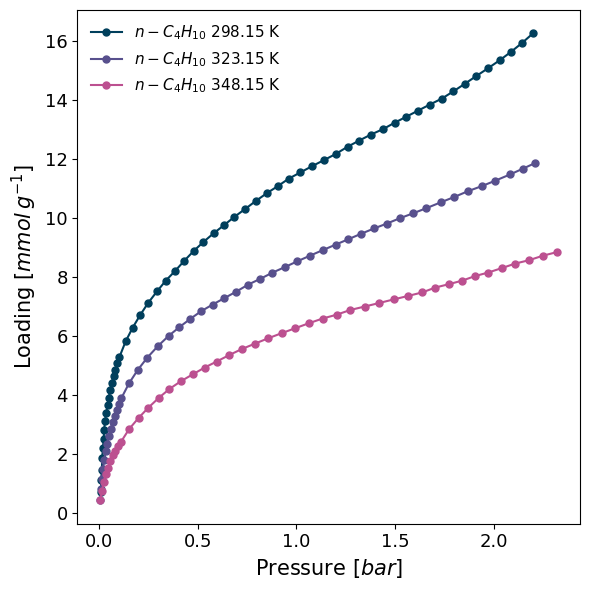
The isotherms look good, except perhaps a bit of measurement error in the low pressure region.
The isosteric enthalpy calculation takes the list of the isotherms and returns the results as a dictionary. Using the verbose keyword, we also generate a graph that includes an error bar.
[3]:
result_dict = pgc.isosteric_enthalpy(isotherms_isosteric, verbose=True)
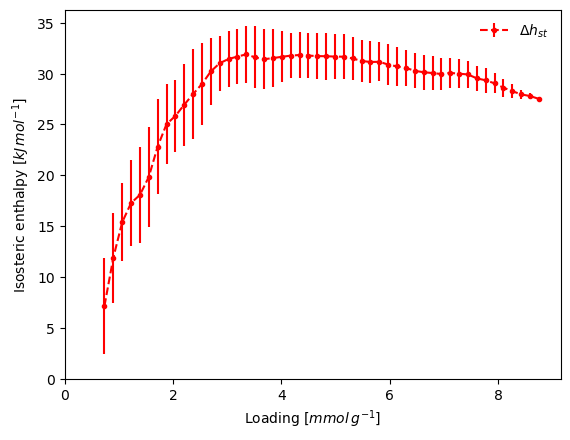
The inaccuracy in the low pressure region has contributed to the odd enthalpy curve. One other option would be to first fit a model to each isotherm, then use it for the enthalpy determination.
Let's try a Double Site Langmuir model and then re-run the isosteric calculation.
[4]:
from pygaps.modelling import model_iso

models_isosteric = [model_iso(iso, model="dslangmuir") for iso in isotherms_isosteric]
result_dict = pgc.isosteric_enthalpy(models_isosteric, verbose=True)
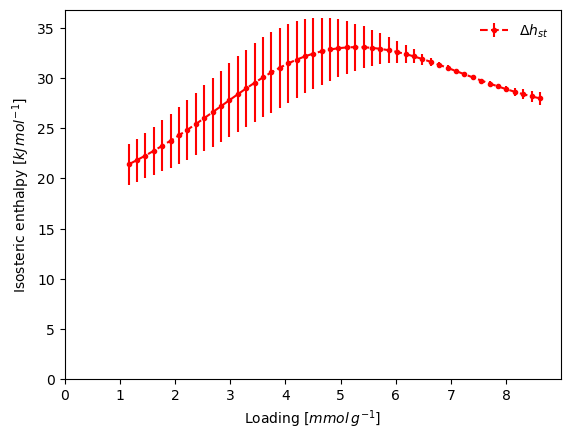
More information about the functions and their use can be found in the manual.
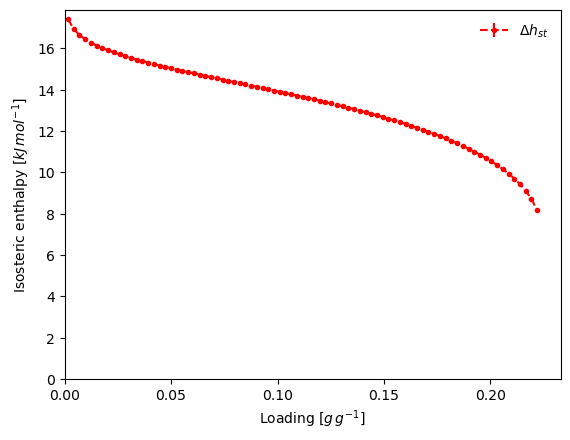
Whittaker method
The Whittaker method uses a Tóth’s modification of Polanyi's potential theory to determine enthalpy of adsorption from a single isotherm fitted with a suitable model. We loaded the example isotherm before, so we can now plot it.
[5]:
pgg.plot_iso(isotherms_enth_whittaker, lgd_keys=['adsorbate', 'temperature'], pressure_unit='bar')
[5]:
<Axes: xlabel='Pressure [$bar$]', ylabel='Loading [$mmol\\/g^{-1}$]'>
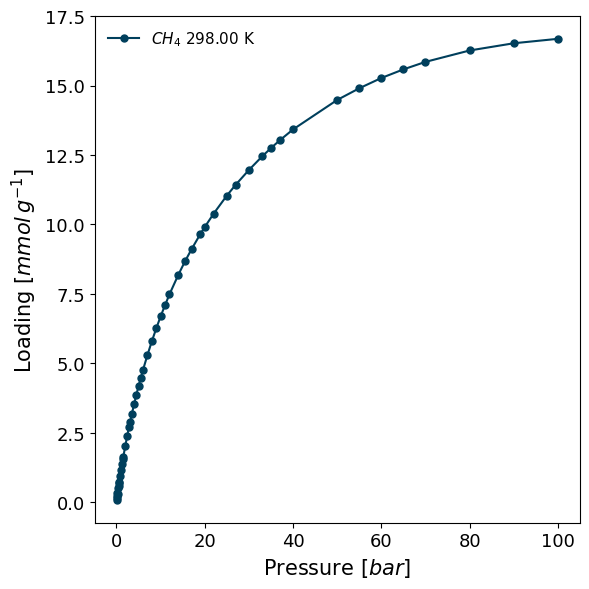
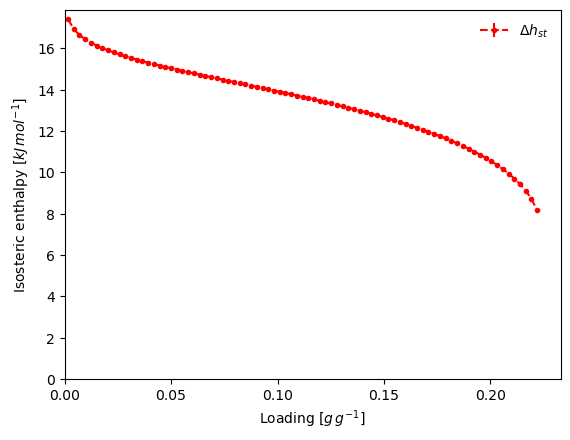
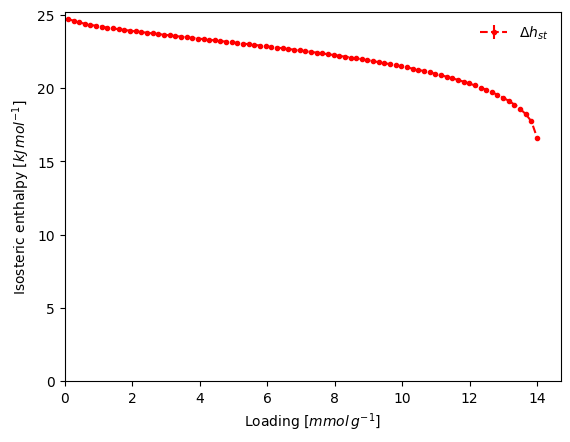
The code can accept a ModelIsotherm of the required type. Note that this isotherm must be in correct pressure mode (absolute) and units: (Pa).
[6]:
import pygaps.modelling as pgm

for iso in isotherms_enth_whittaker:
    iso.convert_pressure(mode_to="absolute", unit_to="Pa")
models_whittaker = pgm.model_iso(
    isotherms_enth_whittaker[0],
    model=pgm._WHITTAKER_MODELS,
    verbose=True
)
result_dict_whitt = pgc.enthalpy_sorption_whittaker(models_whittaker, verbose=True)
Attempting to model using Langmuir.
Model Langmuir success, RMSE is 0.00748
Attempting to model using DSLangmuir.
Model DSLangmuir success, RMSE is 0.00368
Attempting to model using TSLangmuir.
Model TSLangmuir success, RMSE is 0.027
Attempting to model using Toth.
Model Toth success, RMSE is 0.00493
Attempting to model using DSToth.
Model DSToth success, RMSE is 0.0167
Attempting to model using ChemiPhysisorption.
Model ChemiPhysisorption success, RMSE is 0.205
Best model fit is DSLangmuir.
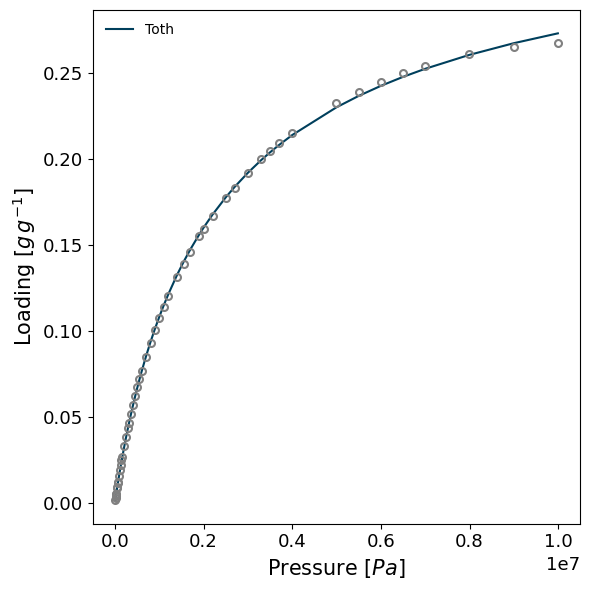
Alternatively, the PointIsotherm and the desired model can be passed as parameters, and fitting is performed automatically before the method is applied.
[7]:
result_dict_whitt = pgc.enthalpy_sorption_whittaker(
    isotherms_enth_whittaker[0],
    model="guess",
    verbose=True
)
Attempting to model using Langmuir.
Model Langmuir success, RMSE is 0.00748
Attempting to model using DSLangmuir.
Model DSLangmuir success, RMSE is 0.00368
Attempting to model using TSLangmuir.
Model TSLangmuir success, RMSE is 0.027
Attempting to model using Toth.
Model Toth success, RMSE is 0.00493
Attempting to model using DSToth.
Model DSToth success, RMSE is 0.0167
Attempting to model using ChemiPhysisorption.
Model ChemiPhysisorption success, RMSE is 0.205
Best model fit is DSLangmuir.
Comparing Whittaker and Clausius-Clapeyron
How do these methods compare? We can use the Whittaker method on each of the isotherms in isotherms_isosteric, and compare with the Clausius-Clapeyron results in result_dict.
[42]:
import pygaps.graphing as pgg
import matplotlib.pyplot as plt

_, ax = plt.subplots(1, 1)  # set up an ax to plot on

for i in isotherms_isosteric:
    # Calculate heat of adsorpation with whittaker method
    whittaker = pgc.enthalpy_sorption_whittaker(
        i,
        model='dslangmuir',  # using DSLangmuir as previously showed good fit
        verbose=False
    )
    print(
        f"{i.temperature}: {whittaker['model_isotherm'].model.rmse}"
    )  # check that fit is reasonable for all models
    ax.errorbar( # and plotting
        whittaker['loading'],
        whittaker['enthalpy_sorption'],
        yerr=whittaker['std_errs'],  # with error bars
        label=str(i.temperature),
    )

# Now plotting Clausis-Clapeyron enthalpies
pgg.calc_graphs.isosteric_enthalpy_plot(
    result_dict['loading'],
    result_dict['isosteric_enthalpy'],
    result_dict['std_errs'],
    units=isotherms_isosteric[0].units,
    ax=ax
)

ax.legend(frameon=False)
298.15: 0.009565136818274825
323.15: 0.005256038450545493
348.15: 0.009516772628472047
[42]:
<matplotlib.legend.Legend at 0x7fb6e7a35cd0>
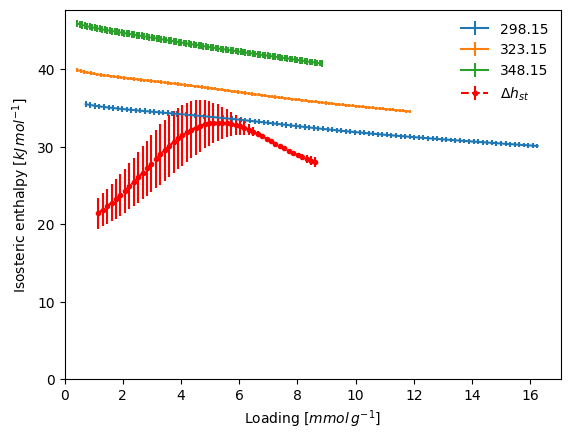
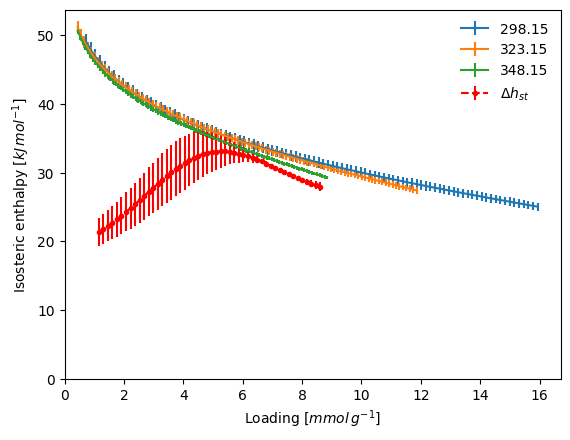
A reasonable match in terms of magnitude of \(\Delta H_{st}\), but not in terms of the overall trend. The Clausius-Clapeyron method predicts increasing enthalpy with loading up to 6 mmol g-1, while the Whittaker method predicts a continuous decrease. Whittaker approximation will always give this decreasing trend.
What happens when we use a different model, say Toth?
[46]:
import pygaps.graphing as pgg
import matplotlib.pyplot as plt

_, ax = plt.subplots(1, 1)  # set up an ax to plot on

for i in isotherms_isosteric:
    # Calculate heat of adsorpation with whittaker method
    whittaker = pgc.enthalpy_sorption_whittaker(
        i,
        model='toth',  # using DSToth
        verbose=False
    )
    print(
        f"{i.temperature}: {whittaker['model_isotherm'].model.rmse}"
    )  # check that fit is reasonable for all models
    ax.errorbar( # and plotting
        whittaker['loading'],
        whittaker['enthalpy_sorption'],
        yerr=whittaker['std_errs'],  # with error bars
        label=str(i.temperature),
    )

# Now plotting Clausis-Clapeyron enthalpies
pgg.calc_graphs.isosteric_enthalpy_plot(
    result_dict['loading'],
    result_dict['isosteric_enthalpy'],
    result_dict['std_errs'],
    units=isotherms_isosteric[0].units,
    ax=ax
)

ax.legend(frameon=False)
---------------------------------------------------------------------------
CalculationError                          Traceback (most recent call last)
Cell In[46], line 8
      4 _, ax = plt.subplots(1, 1)  # set up an ax to plot on
      6 for i in isotherms_isosteric:
      7     # Calculate heat of adsorpation with whittaker method
----> 8     whittaker = pgc.enthalpy_sorption_whittaker(
      9         i,
     10         model='toth',  # using DSToth
     11         verbose=False
     12     )
     13     print(
     14         f"{i.temperature}: {whittaker['model_isotherm'].model.rmse}"
     15     )  # check that fit is reasonable for all models
     16     ax.errorbar( # and plotting
     17         whittaker['loading'],
     18         whittaker['enthalpy_sorption'],
     19         yerr=whittaker['std_errs'],  # with error bars
     20         label=str(i.temperature),
     21     )

File ~/anaconda3/lib/python3.9/site-packages/pygaps/characterisation/enth_sorp_whittaker.py:129, in enthalpy_sorption_whittaker(isotherm, model, loading, verbose, dographs, **kwargs)
    126         model = pgm._WHITTAKER_MODELS
    128     max_nfev = kwargs.get('max_nfev', None)
--> 129     isotherm = pgm.model_iso(
    130         isotherm,
    131         branch='ads',
    132         model=model,
    133         verbose=verbose,
    134         optimization_params=dict(max_nfev=max_nfev)
    135     )
    137     model = isotherm.model.name
    139 if not pgm.is_model_whittaker(model):

File ~/anaconda3/lib/python3.9/site-packages/pygaps/modelling/__init__.py:287, in model_iso(isotherm, branch, model, param_guess, param_bounds, optimization_params, verbose)
    261 """
    262 Fits a PointIsotherm with a model.
    263
   (...)
    284     Prints out extra information about steps taken.
    285 """
    286 from pygaps.core.modelisotherm import ModelIsotherm
--> 287 return ModelIsotherm.from_pointisotherm(
    288     isotherm,
    289     branch=branch,
    290     model=model,
    291     param_guess=param_guess,
    292     param_bounds=param_bounds,
    293     optimization_params=optimization_params,
    294     verbose=verbose,
    295 )

File ~/anaconda3/lib/python3.9/site-packages/pygaps/core/modelisotherm.py:343, in ModelIsotherm.from_pointisotherm(cls, isotherm, branch, model, param_guess, param_bounds, optimization_params, verbose)
    341 if isinstance(model, str):
    342     if model != 'guess':
--> 343         return cls(
    344             branch=branch,
    345             model=model,
    346             param_guess=param_guess,
    347             param_bounds=param_bounds,
    348             optimization_params=optimization_params,
    349             verbose=verbose,
    350             **iso_params
    351         )
    353 return ModelIsotherm.guess(
    354     branch=branch,
    355     models=model,
   (...)
    358     **iso_params
    359 )

File ~/anaconda3/lib/python3.9/site-packages/pygaps/core/modelisotherm.py:212, in ModelIsotherm.__init__(self, pressure, loading, isotherm_data, pressure_key, loading_key, branch, model, param_guess, param_bounds, optimization_params, verbose, **other_properties)
    209         param_guess = self.model.initial_guess(pressure, loading)
    211     # fit model to isotherm data
--> 212     self.model.fit(
    213         pressure,
    214         loading,
    215         param_guess,
    216         optimization_params,
    217         verbose,
    218     )
    220 # Plot fit if verbose
    221 if verbose and other_properties.pop('plot_fit', True):

File ~/anaconda3/lib/python3.9/site-packages/pygaps/modelling/base_model.py:259, in IsothermBaseModel.fit(self, pressure, loading, param_guess, optimization_params, verbose)
    256 if optimization_params:
    257     fit_args.update(optimization_params)
--> 259 opt_res = self.fit_leastsq(fit_args)
    261 # assign params
    262 for i, _ in enumerate(param_names):

File ~/anaconda3/lib/python3.9/site-packages/pygaps/modelling/base_model.py:280, in IsothermBaseModel.fit_leastsq(self, leastsq_args)
    276     raise CalculationError(
    277         f"Fitting routine for {self.name} failed with error:\n\t{err}"
    278     ) from err
    279 if not opt_res.success:
--> 280     raise CalculationError(
    281         f"Fitting routine for {self.name} failed with error:"
    282         f"\n\t{opt_res.message}"
    283         f"\nTry a different starting point in the nonlinear optimization"
    284         f"\nby passing a dictionary of parameter guesses, param_guess, to the constructor."
    285         f"\nDefault starting guess for parameters:"
    286         f"\n{leastsq_args['x0']}\n"
    287     )
    288 return opt_res

CalculationError: Fitting routine for Toth failed with error:
        The maximum number of function evaluations is exceeded.
Try a different starting point in the nonlinear optimization
by passing a dictionary of parameter guesses, param_guess, to the constructor.
Default starting guess for parameters:
[1.78673000e+01 4.93900934e-05 1.00000000e+00]
This gives an error as pgm.model_iso() can't fit the model. We can try to increase the number of function evaluatins max_nfev to see if that helps.
[51]:
import pygaps.graphing as pgg
import matplotlib.pyplot as plt

_, ax = plt.subplots(1, 1)  # set up an ax to plot on

for i in isotherms_isosteric:
    # Calculate heat of adsorpation with whittaker method
    whittaker = pgc.enthalpy_sorption_whittaker(
        i,
        model='toth',  # using Toth
        verbose=False,
        **{'max_nfev': 1e5},  # Increasing number of function evaluations
    )
    print(
        f"{i.temperature}: {whittaker['model_isotherm'].model.rmse}"
    )  # check that fit is reasonable for all models
    ax.errorbar( # and plotting
        whittaker['loading'],
        whittaker['enthalpy_sorption'],
        yerr=whittaker['std_errs'],  # with error bars
        label=str(i.temperature),
    )

# Now plotting Clausis-Clapeyron enthalpies
pgg.calc_graphs.isosteric_enthalpy_plot(
    result_dict['loading'],
    result_dict['isosteric_enthalpy'],
    result_dict['std_errs'],
    units=isotherms_isosteric[0].units,
    ax=ax
)

ax.legend(frameon=False)
298.15: 0.020847257578099514
323.15: 0.01520385363705269
348.15: 0.008170243232597895
[51]:
<matplotlib.legend.Legend at 0x7fb6e7d25190>